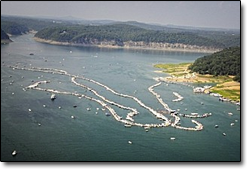
CCYC raft-ups have been in many sizes, from 2 to 23 boats. According to the Guinness Book of World Records, the record for boats rafting together was set on August 14, 2010, when 1,651 boats rafted up at the 1st Annual Lake Cumberland Raft Up in Kentucky. Our gatherings may not be that challenging but we use these guidelines to help avoid accidents, confusion and damage while enjoying our overnight raft-ups and to have a safe and pleasant cruising experience.
Raft Captain/Assistant Raft Captain
- Send information to the Webmaster about such things as:
- Any special theme or arrangements you have made (i.e., dinner reservations, slip arrangements, etc.).
- When you plan on arriving at the raft-up location.
- Any special items to bring (i.e., theme food, your favorite cocktail, etc.).
- Time period you will be monitoring Ch 72.
- Contact information before and during the event, especially boat phone number.
- Contact marinas or restaurants, if appropriate, and coordinate activities such as picnics, cocktail hour, etc.
- Coordinate changes to event with Cruise Director.
- Notify known attendees and Webmaster of any changes to the event's location, itinerary and, if circumstances warrant, if it is being rescheduled or canceled.
- Get approval before your event of any expenditures, if you want to be reimbursed. Approval is needed in writing (emails are acceptable) from the Commodore.
- Monitor ship's radio (VHF Ch 72) and/or cell phone during the agreed time. Reply on minimum power necessary to communicate.
- Decide how many rafts to form and direct each raft-up to balance the boats around the anchor boat(s).
- Decide how many boats should remain rafted overnight.
- If appropriate, direct the break-up of the raft in time to allow boats to get anchored and set.
- Write a post-cruise article for the website.
Anchor Boat
- The Raft Captain does not have to serve as an anchor boat.
- Ground tackle should be capable of holding a raft of several boats in normal situations. Lunch hooks are not acceptable. An oversized anchor and long chain will make the rest of the raft feel much more comfortable overnight.
- A working anchor light, portable or masthead, is required.
- As needed, other boats must be ready to set an additional anchor, to set anchor lights, to operate their motor for maneuvering the raft, or to break up the raft.
Members attending a CCYC event
- Contact the Raft Captain to let him/her know that you will be attending. This is not only out of courtesy but also lets the Captain know whom to contact if there are changes. Let the Raft Captain know if you are willing to serve as an anchor boat and when you arrive, let the Raft Captain know how many boats you are willing to take on your raft.
- Bring your own fenders and lines. (See Equipment)
- Bring whatever is asked for in the way of foodstuffs (i.e., dish to share, etc.).
- Call on Ch 72 as you are approaching to get rafting directions.
Equipment
- Two spring lines.
- Two breast lines. Diameter of all lines should be equal to your regular docking or anchor lines. Multiple bow cleats will make tying off several lines much easier than one large one.
- At least two large fenders capable of completely protecting the side (hull and rail) of your boat. Covering them with colorfast acrylic materials helps to eliminate those annoying rubbing sounds caused by boat movement. Hang your fenders from your lifelines or rail;that way, they will remain with your boat.
Joining The Raft
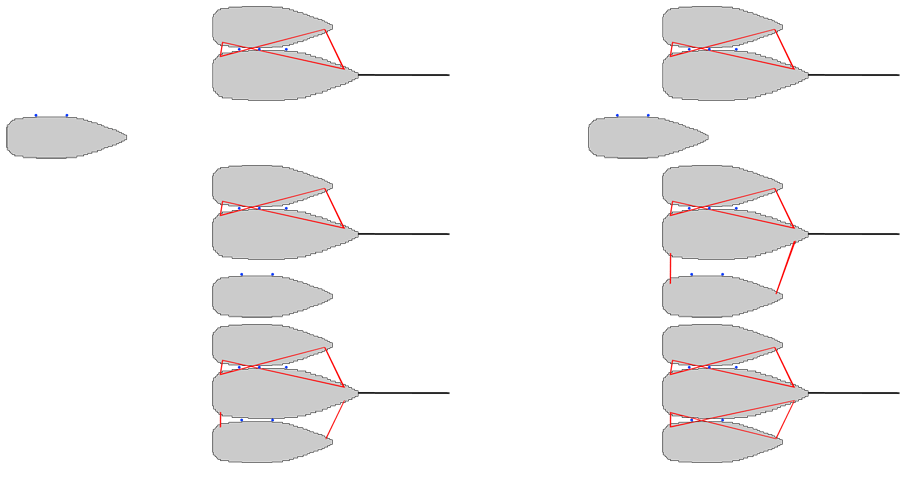
- Approach the raft from astern.
- The Raft Captain will direct you to the side to join.
- Deploy your fenders on the inside of the raft, and have all lines and crew ready for tying up.
- Coast to a stop BESIDE the raft;do not push it around by bumping into it at speed. You need not stop rail-to-rail;just be close enough to toss your lines.
- If a line has a loop, extend the loop end of lines to the inside boat - knots are your responsibility.
- Toss a bow line to the boat inside you. After the other crew has slipped it onto their bow cleat, secure your end to your bow cleat (it will be adjusted later).
- Toss a stern line to the boat inside you. After the other crew has slipped it onto their stern cleat, secure your end to your stern cleat.
- Using these brest lines, pull your boat next to the other boat.
- Run the first spring line from the boat inside yours to your stern. Adjust the spring so that your spreaders are one to three feet aft of the inside boat's spreaders.
- Adjust breast lines so that the centerlines of the two boats are parallel.
- The second spring line, run from the inside boat to your bow, and drawn against the first spring, will prevent the boats from seesawing forward and backward. They must be used for raft maneuvering.
- If these lines are adjusted properly and drawn tightly against one another, the boats will ride easily with minimal contact in waves and winds.
Rafting Courtesy
- Realize that other sailors will be walking across your boat to visit others. Clear away your own sails, lines and articles so as to avoid accidents.
- To maximize privacy, cross only on the forward decks and not the cockpits. Wear clean deck shoes and do not step on sails or other articles.
- Secure all halyards away from masts to prevent slapping noises. Dinghies may need attention also.
- Prepare your boat for any likelihood of bad weather during the night.
- Be available to remove your boat in case of increasing winds.